Rail or Road Through Open Country? Choose by What You Want to See
Rail or road through open country? Compare the views and stopping options to choose a route that fits what you want to see and how you want to travel.
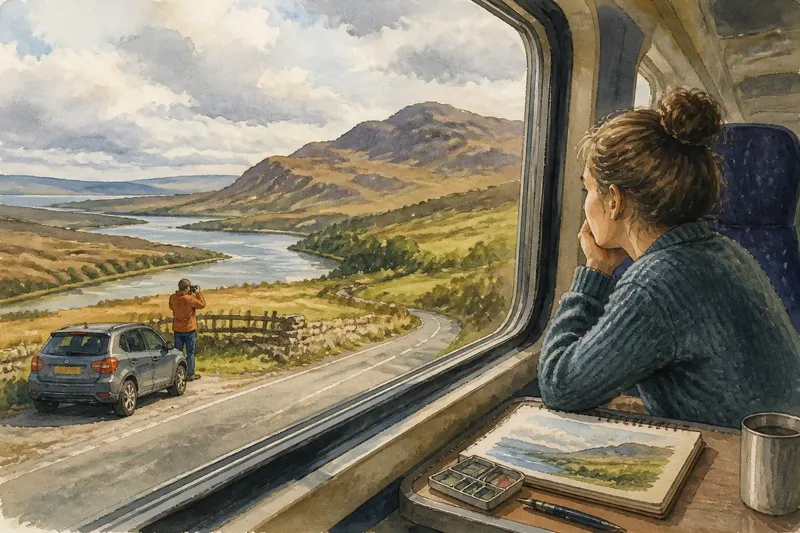
Rail or road through open country: which gives you the day you actually want? Choose rail if you want to watch a broad landscape unfold without driving; choose a car if reaching a particular village, shoreline or viewpoint matters more than a continuous view.
The distinction is less about which one is better and more about where you want your attention. A train frames the countryside as a moving sequence. A car lets you shape the route, but the driver has to keep their eyes on the road.
Choose your view
From a train, you can follow a river as it bends away, notice fields giving way to moorland, or watch cloud shadow cross a ridge. You are free to stay with the view instead of steering. The window works a little like a picture frame being carried along: it reveals one scene, then another, without inviting you to choose where it pauses.
A car offers a different kind of looking. A passenger can study the hills while the driver concentrates, and the group can turn toward an accessible public viewpoint or a village street. The landscape becomes a series of possible visits rather than one long panorama.
Check a route map against the terrain. A rail line following a river may suit someone who wants water and hills in the same view; a road crossing open uplands may bring a passenger nearer to scattered settlements. The map suggests what you might see, but it cannot promise an uninterrupted view: cuttings, trees and buildings can block either route.
Compare the route choices
Rail suits a day with one broad intention: watch the country change, sketch from a seat, or travel without taking on the driving. Its limits are practical. A stop is useful only if a train serves it and you can arrange the next part of the journey.
A car suits a day built around separate destinations, especially when local connections are inconvenient. That freedom comes with a responsibility: the driver cannot safely navigate, take photos or linger over a view while moving. Save those tasks for a proper stop, and use only places where stopping is permitted and safe.
A mixed journey can work when rail covers the long crossing and a local bus, taxi or rental car reaches the final destination. Check that the connection and onward transport fit together before relying on them. If a late change would leave you without a practical way onward, keep the plan simpler.
Match the day to your group
Think about who will be looking and what each person needs. A group that enjoys quiet observation may be content on a train, while travelers who want to stretch their legs or explore a settlement may prefer a road journey with planned stops.
Solo travelers can watch the landscape from a train without dividing attention between the view and driving. A solo driver has more control over the route, but should save map checks and sightseeing for a safe stop. With a passenger, you can share navigation and conversation, though the driver still needs to concentrate.
Say you and a friend are planning a day across open country. The starting point is a rail line with a long view of a ridge, while a small settlement you both want to visit lies off the line; your friend wants to sketch the ridge, and you want time to walk through the settlement. First, agree that the settlement is the shared priority. Then check whether a train station and onward bus or taxi make the visit workable. If they do, take rail for the crossing and arrange the local connection; the expected result is a settled drawing session on the journey and a separate visit together. If no workable connection appears, drive only if one of you can take responsibility for driving and the route has appropriate stopping places; otherwise, choose the rail journey and save the settlement for another day.
Decide what matters more?
Is a train better for sightseeing?
It can be, if you want to watch the landscape continuously without concentrating on driving. The trade-off is less choice about where to stop and how long to stay.
Is a car better for remote places?
A car may reach places that are awkward to connect by rail, but a remote destination is not automatically an easy stop. Check the road, access arrangements and suitable places to pull in before choosing it.
Can I combine rail and road?
Often you can pair rail with a local bus, taxi or rental car where services are available. Confirm the connection and pickup arrangements before setting out, especially if the final stop depends on them.
Which works better for a one-way trip?
Rail can simplify a one-way journey because there is no vehicle to return to the starting point. A car can still fit if you have a clear drop-off plan and want control over stops; compare the whole route, including how you will leave the destination.
Make the final choice
Before booking, name the scene or stop you most want from the day. If it is the gradual shift from farmland to open hills, rail may give you more time to watch it. If it is a particular shoreline or settlement, check whether road access and appropriate stopping places make the visit practical.
- Observation: you want an uninterrupted view and do not need to stop at a particular place. If rail serves the route, choose the train; otherwise, consider a road journey with a passenger able to look outward.
- Observation: the driver would miss the scenery by watching the road. If the view is the main point, choose rail; alternatively, take a car only if someone else can drive.
- Observation: your main destination lies away from the rail line. If a suitable road and permitted stopping place are available, choose a car; otherwise, check local transport or select a destination served by rail.
- Observation: you want to leave the train and continue elsewhere. If a connection and onward service fit your plan, choose the mixed route; otherwise, stay on the train for the full journey or choose a direct road route.
- Observation: your group wants to spend time walking around a settlement. If the transport plan allows a comfortable visit, choose the option that gets you there; otherwise, agree on a different shared stop.
- Observation: a one-way trip would leave a car at the destination. If you have a clear drop-off plan, road travel remains an option; otherwise, choose rail or arrange transport back before setting out.
For rail or road through open country, decide first whether the journey itself or a particular stop matters more. That answer will usually point you toward the route that fits. Before you leave, confirm the actual service or road access for your chosen plan; a route that works on the map still needs a workable way to begin, pause and finish.