Before the Resort: How Northern Spa Towns Took Shape
Northern spa towns grew around mineral springs in different ways. Learn how to read their buildings and street plans for clues to each town’s visitor history.
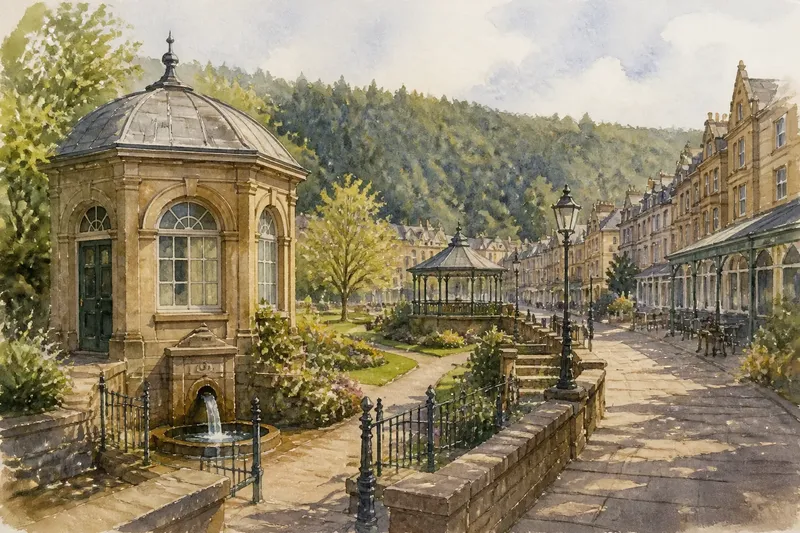
What are you really looking at when a spring, a garden, and an old hotel share the center of a northern town? Northern spa towns did not all develop along one route: the water might serve local residents, draw visitors seeking a cure, or become part of a broader leisure destination. Reading the place as it stands can reveal how those roles overlapped.
Springs and settlement
A mineral spring could give a settlement a reason to attract attention, but its reputation and visitor facilities developed locally. Residents might already know where the water emerged and how to reach it; visitors needed places to drink or bathe, rest, eat, and spend time between visits. Those needs could bring new buildings and businesses to an existing community rather than replace it.
Look for the connections between the spring and the town. A path may lead to a pump room or bath building, while lodging and food businesses may cluster along the approach. In other places, the water-related buildings sit apart from the main streets, suggesting that the visitor experience was arranged around a distinct destination within the settlement.
Northern terrain and weather shaped what visitors could comfortably do, but not in one uniform way. A wooded slope, open hillside, or sheltered valley might offer walking routes; rain and cold could make indoor gathering rooms useful. These are possibilities to consider while looking at a town, not a formula that explains every resort.
Different visitor roles
Water as remedy
Where visitors came chiefly for the spring’s perceived medicinal value, facilities and lodging might be organized around drinking or bathing. The daily rhythm could include a visit to the water, rest, and a gentle walk. A pump room or bath building may remain a prominent clue to the spring’s importance, though its presence alone cannot tell the whole story.
Leisure and company
Elsewhere, a spring could become one part of a broader social visit. Gardens, promenades, assembly rooms, cafés, or music spaces might give visitors reasons to spend time together beyond the water. If these features survive, their arrangement can help show how public leisure fitted into the town’s visitor life.
That pattern should be read as a possibility, not a claim that every northern spa town developed the same way. A public garden beside a spring may suggest a leisure role, but local histories, maps, and building records are needed to establish when and why those places were made.
Access and arrival
Roads, coach routes, and rail connections could affect how easily visitors reached a settlement. To assess that influence in a particular town, look for the relationship between an old arrival route, lodging, the spring, and public spaces. The layout may suggest a connection; local records are needed to support a specific historical account.
Access did not create the water, and it did not dictate what a town became. It could, however, make a known spring easier for outsiders to visit, while transport activity and local needs competed for space. Treat arrival routes as one clue among several rather than as proof of a single development story.
Reading the town today
Buildings and street plans can suggest what mattered, but they are not a complete record. A cluster of water-related structures may point to the spring’s central role; a promenade or formal garden may indicate public leisure; lodging near an old arrival route may invite questions about visitors and transport. Later reuse can obscure those original purposes.
As you walk, notice where paths lead and which buildings sit together. Does a route favor the water, a garden, or a former arrival point? Think of the town plan like a wooden box with compartments: the arrangement offers clues, even if the contents have since changed.
For a traveler, these distinctions can help shape a visit. If the spring’s built history interests you, start near its surviving water buildings; if public leisure is your focus, follow the gardens and promenades. To understand how visitors arrived, trace the older approach into the center and compare it with the location of lodging and gathering places.
Which clues answer your questions?
Why did towns develop around springs?
A spring could attract people seeking its water, and their visits created needs for places to stay, eat, bathe, and rest. How those services affected a particular settlement depends on its local history.
Did every spa town begin as a resort?
No single pattern fits every town. A spring might have served nearby residents before attracting visitors, while visitor facilities could be added gradually to an established settlement.
How can I distinguish cure from leisure?
Compare the location of water buildings with gardens, promenades, gathering rooms, and older lodging. Their arrangement offers clues, but local records are needed to confirm the town’s particular history.
What should I look for on a short visit?
Choose one thread—spring buildings, public spaces, or arrival routes—and follow how it connects to the town center. That focused walk can make the layout easier to read without assuming that one feature explains the whole settlement.
A focused town walk
Say you have an afternoon in an unfamiliar northern spa town and want to understand its social spaces. You start at the old station approach shown on a local heritage map, follow it toward a surviving promenade, then note where nearby lodging and gathering rooms stand. The result is a clearer set of questions about how arrival and leisure related; a map or local history can help check whether that layout reflects the town’s development.
Before setting out, use these observations to choose what to investigate next:
- Check whether a spring or pump room is open to view; if it is, begin there to trace the water-centered story, and if it is not, use an interpretive sign or local map instead.
- Check whether a path links the spring buildings to the town center; if it does, follow that route to see how the water connects to daily streets, and if it does not, compare the locations on a map.
- Check whether a formal garden or promenade survives; if it does, walk its connection to nearby public buildings, and if it does not, look for a historic map or description of former public spaces.
- Check whether older lodging clusters near the spring; if it does, investigate a water-centered visitor pattern, and if it does not, compare lodging locations with other gathering places.
- Check whether the old arrival route leads toward the center; if it does, trace its links to lodging and public spaces, and if it does not, consult local records before drawing conclusions about transport’s role.
- Check whether buildings have been reused or substantially altered; if they have, treat their present appearance cautiously and seek historical images or records, and if they have not, use their location as a clue rather than definitive evidence.
Northern spa towns are best understood as distinct settlements, not as variations on a single script. For a closer reading of a northern spa town, follow the links among water, public space, lodging, and arrival—then use local history to test what the surviving layout suggests.